
Love Tarot Card Meanings: How to Read the Cards for Your Relationship
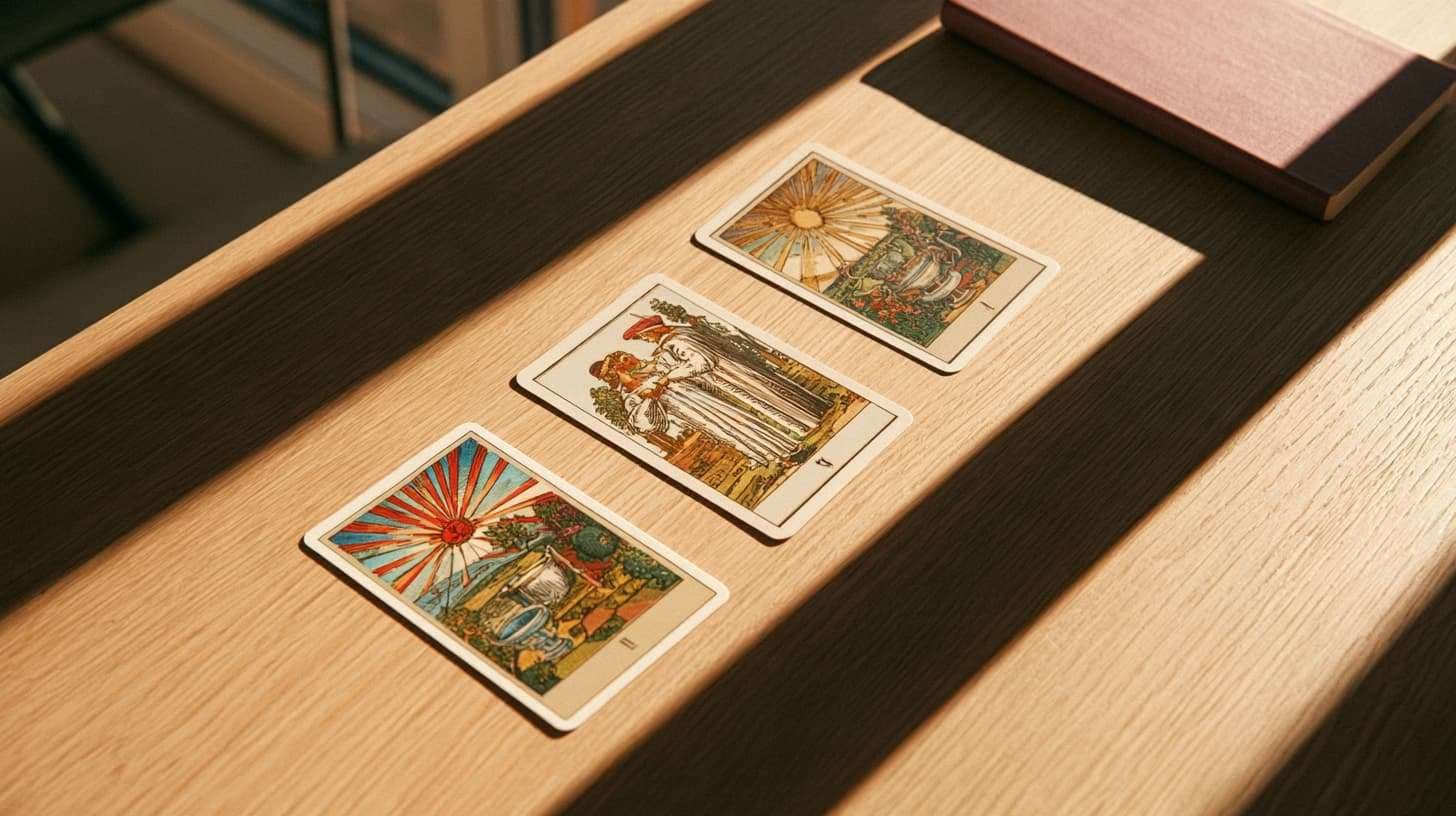
Three cards are on the table, and you’re looking at the middle one again. The Lovers sounds hopeful. The Three of Swords feels harder to sit with. Before you’ve considered the question you asked, you’re already building a story about what happens next.
In short: Love tarot card meanings are symbolic interpretations of cards in a relationship reading. A card’s position, the question and the reader’s approach all shape that interpretation. The Lovers often introduces themes of connection and choice; the Two of Cups, mutual exchange. Neither establishes another person’s feelings or guarantees an outcome.
You don’t need to memorise a whole deck to begin. Start with the card you pulled, then connect its theme to your question. This guide covers eight useful starting points and shows how to turn a reading into reflection without asking a card to make your decisions.
Read the Question Before You Read the Card
“What does The Lovers mean?” and “What does The Lovers mean in an advice position after a breakup?” are different questions. The first asks for a theme. The second asks how someone would apply that theme in a particular situation. Begin by writing the question exactly as you asked it.
Next, note the position. Was this card meant to represent your concern, an obstacle, advice or a possible outcome? If you used no positions, record that too. Giving a card a new role after seeing it can quietly change the reading into the answer you were hoping to receive.
Meaning, interpretation and action are different steps
A meaning is a starting association, such as reciprocity. An interpretation applies it: “This reading invites me to consider how we share effort.” An action is something you choose: “I’ll ask if we can take turns organising dates.” Those steps connect, but they aren’t interchangeable.
A statement such as “He’ll call because the Two of Cups appeared” jumps from symbolism to a claim about someone else. You can enjoy the symbolism while leaving that claim unconfirmed. The more useful question is what the card helps you notice about your own expectations and the relationship on offer.
Keep your deck’s approach in view
The examples below use associations found in contemporary Rider-Waite-Smith-based guides. Tarot authors don’t agree on every detail. For example, Tina Gong’s Lovers guide discusses both partnership and choice. That range is a reason to explain an interpretation, rather than present one keyword as the entire answer.
Key takeaway: Write down the question and card position before interpreting the image. A symbolic theme becomes useful when you can explain how it relates to your situation.
Eight Love Tarot Card Meanings to Start With
These are brief interpretations, not promises or fixed rules. Each card includes a practical question. Use the linked articles when you want to explore a particular card in more depth; you don’t have to read every guide before making sense of your own spread.
The Lovers: connection and a choice you can name
The Lovers is commonly associated with attraction, partnership and choices about what matters to you. In a love reading, it offers more to consider than a simple romantic yes. What are you choosing, and does that choice fit the relationship you want?
The card doesn’t identify a destined person. Our guide to The Lovers in a love reading explores this card further.
Try asking: “Where do my choices match my values, and where am I making exceptions I haven’t acknowledged?”
Two of Cups: the exchange between two people
The Two of Cups commonly introduces themes of partnership and mutual connection. Labyrinthos describes it through unity and exchange. In a reflective reading, you can use that theme to consider what each person contributes and what remains unspoken.
It doesn’t mean both people feel exactly the same thing. Instead of trying to measure their feelings through the card, think about examples of listening, initiative and follow-through. Read our Two of Cups love meaning guide for a closer look at the symbolism.
Try asking: “What does mutual effort look like in this relationship, beyond the moments when we feel close?”
Ace of Cups: room for a new feeling
The Ace of Cups is often associated with emotional beginnings and openness. That can be a useful theme when you’re considering dating again, naming affection or making room for tenderness in an existing relationship. A beginning doesn’t have to mean a new person is about to arrive.
Try asking: “What kind of connection am I willing to make room for now?”
Six of Cups: memories and the pull of familiarity
The Six of Cups is commonly read through memory, nostalgia and familiar connections. That makes it a natural card to discuss after a breakup, but remembering someone and rebuilding a relationship are separate matters. A warm memory doesn’t describe their current wishes.
Write down what you miss in concrete terms: their humour, a shared routine, feeling understood, or the life you expected to have together. Some of those wishes concern a particular person; others describe experiences you still want. Our article on tarot and reconciliation explores the related card symbolism. Keep any reunion interpretation separate from evidence of mutual interest.
Try asking: “What am I remembering accurately, and what part of the story am I leaving out?”
Ten of Cups: the relationship picture you’re carrying
The Ten of Cups is often associated with emotional fulfilment, harmony and shared happiness. As a reflection prompt, it invites you to describe what a satisfying life together would involve. That answer needn’t look like anyone else’s household, timeline or definition of commitment.
Go beyond the attractive picture. Consider ordinary evenings, responsibilities, friendships and the way you’d like to handle disagreement. If two people want different versions of a future, a positive card doesn’t resolve that difference. Naming it gives you something real to discuss.
Try asking: “What does a good shared life look like on an ordinary weekday?”
Three of Swords: hurt that deserves an honest name
The Three of Swords is associated with sorrow, heartbreak and painful separation. It can provide a starting point for acknowledging disappointment you’ve been trying to minimise. It is not proof of cheating, a third person or an approaching breakup.
If you’re already hurt, describe what happened before deciding what the card adds. If nothing concrete has happened, don’t create an accusation to fit the image. You can ask what support or conversation you need without treating the card as evidence against someone.
Try asking: “What has hurt me, and what would help me respond to that actual experience?”
Death: an ending, a transition or something to release
Many contemporary readers associate Death with endings and change. In a relationship reading, that can introduce questions about an arrangement, an expectation or a stage of life. It doesn’t automatically instruct you to end a relationship, and it is not a medical prediction.
If it appears in an advice position, consider what you’re ready to stop carrying or repeating. In an outcome position, keep the interpretation open rather than treating it as a fixed event. You still decide which changes you want, and which conversations are needed before making them.
Try asking: “What am I trying to preserve, and do I still want it in its current form?”
The Star: hope you can bring into the present
The Star is commonly associated with hope, renewal and renewed trust. After disappointment, it can serve as a prompt to imagine possibilities beyond the situation occupying all your attention. Hope doesn’t have to mean waiting for one person to change their mind.
Ask what would make the coming week feel more open: seeing a friend, returning to an interest or making space for a different plan. These are choices you can make without needing a prediction. A hopeful reading can accompany them without promising a particular romantic result.
Try asking: “What would I like to move towards, even while some questions remain unanswered?”
Key takeaway: Begin with a card’s symbolic theme, then ask a question you can explore. A hopeful image doesn’t prove a reunion, and a difficult image doesn’t establish a betrayal.
How Position and Reversals Change a Love Reading
Reading cards together involves more than adding keywords. The same card can introduce a different question in an advice position than in a position describing a concern. A reversal also depends on the method being used; it isn’t a universal instruction to turn a positive meaning into a negative one.
One card, three positions
Take the Two of Cups as a worked example. In a position called “What I want,” you could explore your wish for mutual affection. In “What needs attention,” consider how you discuss giving and receiving. In “My next step,” think about a conversation that would make your expectations easier to understand.
The card hasn’t changed. The task assigned to it has. None of these interpretations requires a claim that you’ve discovered someone’s hidden feelings. Try writing the position at the start of your interpretation so you can see whether the sentence actually answers it.
Choose your approach to reversals beforehand
Some readers use reversed cards to explore obstruction, an inward focus or an imbalance; others work only with upright cards. Ask a reader which approach they use, or choose your own method before drawing. Consistency makes it easier to explain your interpretation afterwards.
Don’t make a combination into a verdict
Imagine The Lovers alongside the Three of Swords. A reader could explore a painful choice, disappointment within a connection or a decision shaped by previous hurt. Those are different interpretations, and the spread position and real situation matter when discussing them.
Key takeaway: Position and method shape the interpretation. Ask how the reader reached their conclusion, especially when they describe something you cannot independently check.
A Simple Three-Card Love Reflection
Here’s an optional layout for exploring your own choices. The prompts are editorial suggestions, not a method for verifying a partner’s intentions. Write the three positions before drawing: “What I’m bringing,” “What needs attention” and “One next step I can choose.”
Write one sentence for each card
Under the first card, describe your expectations or hopes. Under the second, name something you’d like to examine. Under the third, suggest a response you control. Keep your sentences tied to the position instead of turning every card into a description of the other person.
For a hypothetical example, the Ace of Cups in the first position could introduce readiness to date. The Lovers in the second could prompt you to name your priorities. The Two of Cups in the third could suggest discussing what mutual interest looks like before making assumptions about commitment.
Check the reading against ordinary life
Now add a sentence beginning “What I know is…” Perhaps you’ve enjoyed two dates, but neither of you has discussed exclusivity. A useful next step is a conversation about expectations. The reading hasn’t established the answer; it has helped you formulate a question.
If the exercise leaves you more unsettled, put it aside. You don’t have to keep pulling cards until a story feels reassuring. Save your notes, return to your usual activities and decide later whether there’s anything useful to keep.
You don’t need a perfect interpretation to ask an honest question.
Bring a Focused Question to a Tarot Reader
A conversation with a reader can introduce a different interpretation or help you understand an unfamiliar card. Ask about their deck and approach, explain the question you want to explore, and say when an interpretation doesn’t fit. You don’t need to agree with every statement for the conversation to be respectful.
Useful opening questions include “How would you read this card in an advice position?” and “What other interpretation would you consider?” If you want help preparing, our first love psychic chat guide covers the format. Check current prices and offer conditions before starting a paid session.
Mystic Chat offers paid readings by text chat. Choose a reader whose profile mentions tarot if that is the method you want. A reading offers spiritual interpretation, not access to a partner’s private thoughts. Keep your budget and the next decision in your own hands.
Key takeaway: Bring the question, the cards and their positions. Ask for an explanation you can follow, then decide what is useful to you.
Love Tarot: Questions Before Your Next Reading
Which tarot cards are associated with love?
The Lovers, Two of Cups, Ace of Cups and Ten of Cups are common starting points for discussing romantic connection. Other cards introduce themes such as memory, disappointment or change. The question and position matter more than sorting the entire deck into love cards and non-love cards.
Does The Lovers mean I’ve found my soulmate?
No card can establish that someone is your soulmate. The Lovers can invite reflection on attraction, connection and choices. Consider how the relationship works in practice alongside any spiritual meaning you find in the image.
What is the difference between The Lovers and the Two of Cups?
One useful distinction is choice and values for The Lovers, and mutual exchange for the Two of Cups. Their meanings overlap, and different readers give them different emphasis. Ask how the distinction applies to your particular question rather than treating it as a fixed rule.
Can a tarot reading tell me how someone feels?
It can offer an interpretation about feelings, but it cannot verify another person’s private experience. Keep that interpretation separate from their words and actions. If you need to understand their intentions, a card does not replace a conversation.
Does a reversed card mean the relationship is doomed?
No. A reversal is part of an interpretive method, not a verdict. Ask what approach the reader is using and what question the reversal raises. You’re free to question an explanation that turns a single card into a certainty.
Which tarot card means an ex will come back?
No card guarantees that an ex will return. The Six of Cups is often discussed in connection with memories and past relationships, but that symbolism doesn’t establish an intention to reconnect. Look for actual, mutual communication before planning around a reunion.
Does the Death card mean we should break up?
Not automatically. Readers often discuss it through endings and change, but the spread doesn’t make the decision for you. Consider what is changing and what you want before applying the image to a specific action.
Can I use this guide if I’m single?
Yes. You can explore your preferences, readiness and choices without asking the deck to identify a future partner. The examples work as reflection prompts even when there isn’t a particular person in the picture.
Should I keep drawing until I understand?
You don’t have to. Write down what remains unclear and stop when the exercise stops being useful. Another card can introduce another interpretation without resolving the original question. A break is a valid next step.
Do I need a paid reading to use these meanings?
No. You can use this guide alongside your deck’s instructions and your own notes. A paid reading is optional. If you choose one, check the reader’s method, price and any introductory conditions before the conversation begins.
About the Author
Prepared by Mystic Chat’s editorial team. Mystic Chat provides paid psychic chat services. Card associations were checked against the referenced tarot guides; the exercises and examples are editorial reflection prompts.
Disclaimer: Psychic and tarot readings are for entertainment and personal reflection. They do not replace qualified professional advice or establish another person’s intentions.
Connect with Jack and get clear answers about your situation.